
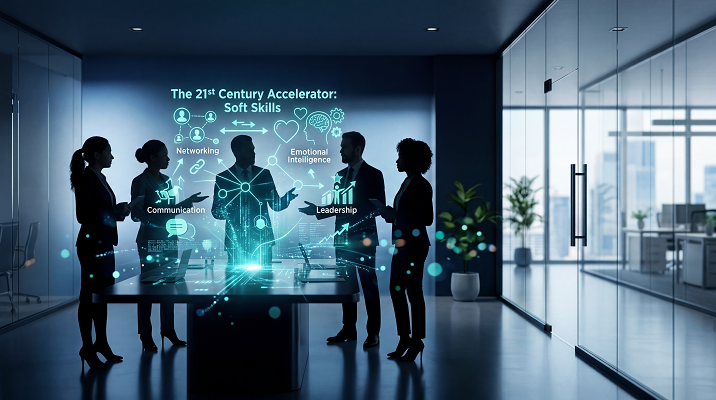
The 21st Century Accelerator: Soft Skills & Professional Readiness
Course Title: The 21st Century Accelerator: Soft Skills & Professional Readiness Target Audience: Gen Z Entering the Workforce (University Students & First-Time Job Seekers) Framework: The Velocity Framework™ (Micro-Mastery + Rapid-Feedback Loop) Curriculum Standard: Mapped to the World Economic Forum …

Overview
Course Title: The 21st Century Accelerator: Soft Skills & Professional Readiness
- Target Audience: Gen Z Entering the Workforce (University Students & First-Time Job Seekers)
- Framework: The Velocity Framework™ (Micro-Mastery + Rapid-Feedback Loop)
- Curriculum Standard: Mapped to the World Economic Forum (WEF) 2025 Skills Outlook and the SHRM (Society for Human Resource Management) Behavioral Competency Model.
Course Philosophy
For Gen Z, soft skills are not abstract “niceties”; they are the primary differentiator in an AI-driven economy. This course reframes these skills as high-value “Technical Competencies in Human Interaction.” The program is split into Velo-Modules, designed for rapid consumption and immediate, real-world testing.
Phase 1: The Personal Toolkit (Self-Management)
Goal: Transitioning from “Student” to “Professional” by mastering internal behavioral logic.
- Velo-Module 1: The Feedback-Fuel Initiative
- The Content: The “Self-Audit” for feedback receptivity. Learning the Receive-Clarify-Action (RCA) framework. Understanding the psychological difference between constructive feedback and personal criticism.
- The Velocity Application: The 24-Hour Feedback Trial. Students must solicit one piece of constructive feedback from a mentor or peer and document how they implemented one tangible change within 24 hours. No lecture, just action.
- Velo-Module 2: Radical Resilience & Adaptive Stress
- The Content: Reframing failure not as “Loss” but as “Data.” Time-Boxing vs. Multitasking. Understanding the Cortisol-Clarity Curve and how to maintain executive function under pressure.
- The Velocity Application: The Failure Log & Pivot. Students document a recent academic or professional setback, identify three objective data points (lessons), and present one specific “Pivot Strategy” for their next attempt.
Phase 2: The Social Operating System (Team Dynamics)
Goal: Engineering empathy and influence for high-performance teamwork.
- Velo-Module 3: Conflict Optimization & Active De-Escalation
- The Content: Mastering the “I” Statement. Understanding conflict styles using the Thomas-Kilmann Conflict Mode Instrument (TKI). The psychology of active listening—listening to understand, not just to respond.
- The Velocity Application: Roleplay Crisis Simulation. Students engage in a timed workplace scenario (e.g., a missed deadline or project friction). They must use TKI styles to move from “Argument” to “Agreed Resolution” in under 5 minutes.
- Velo-Module 4: Hybrid Inclusivity & Ethical Empathy
- The Content: Cultural Intelligence (CQ). Navigating cross-cultural conversations, implicit bias, and professional allyship in a globalized, hybrid work environment.
- The Velocity Application: The Culture Gap Project. Pairs research a corporate norm in a different region and present one way a local team must adapt its communication style to bridge the gap and leverage diversity for innovation.
Phase 3: The Insight & Governance Lens (Visual Leadership)
Goal: Protecting data health through governance and communicating the narrative to stakeholders.
- Module 5: Ethical Governance & The “Single Source of Truth”
- The Content: Compliance & Integrity. Setting up “Guardrails” to ensure data integrity follows international standards (e.g., GDPR, ISO 27001, or local labor laws), preventing human error at the source.
- The Dual-Lens Application: Compliance as an Asset. Students build automated “Check Sheets” with Boolean ($True/False$) alerts to flag when a standard operating procedure (SOP) is ignored. They don’t just find errors; they prevent them.
- Velo-Module 6: Storytelling with Data: The One-Page Pivot
- The Content: Distilling 10,000 rows of raw data (HR metrics, production logs, or budgets) into a single, high-impact visual summary.
- The Velocity Application: The Executive “Why” Presentation. The final presentation must use a Combination Chart (e.g., a Waterfall Chart) to explain the one critical pivot needed to solve a business problem (e.g., increasing ROI or decreasing turnover) in under 30 seconds.
Learning Outcomes
By the conclusion of this program, participants will be able to:
- Transform negative feedback into quantified operational improvements.
- Navigate and de-escalate workplace conflict using established psychological models.
- Build a model of inclusive collaboration for distributed and diverse teams.
- Communicate complex narratives through data-driven storytelling to drive executive decisions.
Curriculum
Instructor
Reviews
You May Like
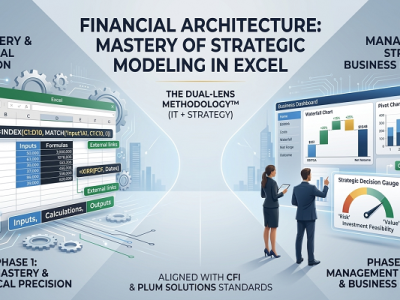
Financial Architecture: Mastering Strategic Modeling in Excel
Course Title: Financial Architecture: Mastery of Strategic Modeling in Excel Focus: Corporate Finance, Investment Analysis, and Advanced Spreadsheet Logic Standard: Aligned with Global Financial...

Beyond the Cells | Excel Foundation
Transforming Excel from a spreadsheet into a robust, automated database.

Excel : Advanced Data Architecture & Strategic Business Intelligence
Transforming Excel from a spreadsheet into a robust, automated database.
Course Features
- Lectures 0
- Quizzes 0
- Duration 10 weeks
- Skill level All levels
- Language English
- Students 0
- Assessments Yes