
Financial Architecture: Mastering Strategic Modeling in Excel
Course Title: Financial Architecture: Mastery of Strategic Modeling in Excel Focus: Corporate Finance, Investment Analysis, and Advanced Spreadsheet Logic Standard: Aligned with Global Financial Modeling Frameworks Course Philosophy Financial modeling is not merely a technical exercise in spreadsheet engineering; it …

Overview
Course Title: Financial Architecture: Mastery of Strategic Modeling in Excel
Focus: Corporate Finance, Investment Analysis, and Advanced Spreadsheet Logic
Standard: Aligned with Global Financial Modeling Frameworks
Course Philosophy
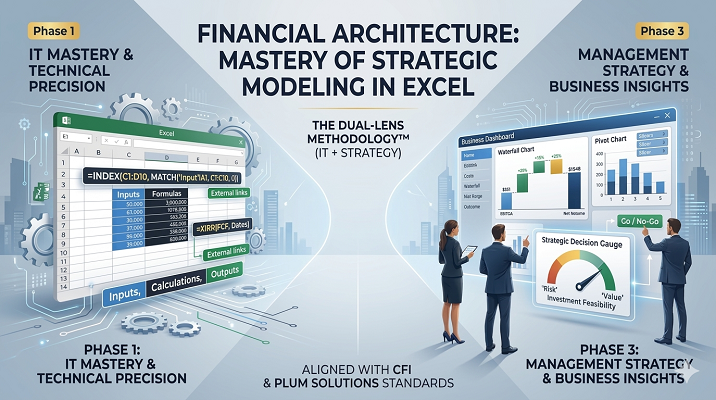
Financial modeling is not merely a technical exercise in spreadsheet engineering; it is the art of translating business assumptions into a logical, mathematical roadmap. This course focuses on the Four Pillars of a Professional Model: Accuracy, Flexibility, Structural Integrity, and Aesthetic Clarity.
Detailed Module Breakdown
Module 1: The High-Performance Environment
Objective: Transitioning from a casual user to a professional modeler through speed and standardization.
- The “Mouse-Free” Methodology: Mastering essential shortcuts (Alt-keys, Ctrl-brackets) to ensure modeling speed.
- Structural Architecture: Setting up a model with dedicated sections for Inputs, Calculations, and Outputs (the “Sheet Integrity” rule).
- Audit-Ready Formatting: Color-coding standards (Blue for inputs, Black for formulas, Green for external links).
Module 2: Advanced Logical & Search Architecture
Objective: Building dynamic models that adapt to changing data without manual updates.
- Beyond VLOOKUP: Mastering the INDEX-MATCH and XLOOKUP frameworks for non-linear data retrieval.
- Nested Logic & Error Trapping: Utilizing IFERROR, IFS, and SWITCH to manage complex decision trees.
- Dynamic Offsets: Using OFFSET and COUNTA to build ranges that expand automatically as data is added.
Module 3: Project Valuation & Capital Budgeting
Objective: Applying Excel to the core questions of Corporate Finance.
- Cash Flow Modeling: Building Free Cash Flow (FCF) schedules from scratch.
- Investment Metrics: Calculating and interpreting NPV (Net Present Value), XIRR (Internal Rate of Return for irregular dates), and Payback Periods.
- Cost of Capital: A step-by-step assembly of the WACC (Weighted Average Cost of Capital) calculation.
Module 4: Scenario Planning & “What-If” Analysis
Objective: Stress-testing assumptions to prepare for real-world volatility.
- Sensitivity Analysis: Creating Data Tables (1-variable and 2-variable) to visualize how changing one driver impacts the bottom line.
- The Scenario Manager: Using the CHOOSE function to build a master toggle for “Bull,” “Bear,” and “Base” cases.
- Goal Seek & Solver: Back-solving for required inputs to achieve a specific target (e.g., “What price must we charge to hit a 15% IRR?”).
Module 5: Model Integrity & Error Defense
Objective: Ensuring the model is reliable, bulletproof, and professional.
- Building Automated Error Checks: Creating a “Check Sheet” with Boolean logic (True/False) to flag balance sheet imbalances or formula breaks.
- Tolerance Alerts: Allowing for minor rounding differences without triggering false alarms.
- Protection & Security: Finalizing models for stakeholder distribution using cell locking and hidden calculations.
Module 6: Data Visualization for Stakeholders
Objective: Translating complex numbers into a compelling narrative.
- Dynamic Charting: Creating dashboards that update based on scenario selections.
- Waterfall & Bridge Charts: Visualizing the walk from EBITDA to Net Income.
- The Executive Summary: Designing a one-page “Output” sheet that provides all critical KPIs at a glance.
Learning Outcomes
By the end of this program, participants will be able to:
- Construct a fully linked 3-statement financial model from a blank workbook.
- Evaluate the feasibility of corporate projects using industry-standard valuation techniques.
- Minimize risk by implementing rigorous auditing and error-check protocols.
- Present complex financial data through professional-grade visualizations.
Participant Profile
This course is intended for Finance Professionals, Business Analysts, Educators, and Students of Management who seek to master the intersection of technical IT mastery and strategic financial application.
Curriculum
Instructor
Reviews
You May Like

The 21st Century Accelerator: Soft Skills & Professional Readiness
Course Title: The 21st Century Accelerator: Soft Skills & Professional Readiness Target Audience: Gen Z Entering the Workforce (University Students & First-Time Job Seekers)...

Beyond the Cells | Excel Foundation
Transforming Excel from a spreadsheet into a robust, automated database.

Excel : Advanced Data Architecture & Strategic Business Intelligence
Transforming Excel from a spreadsheet into a robust, automated database.
Course Features
- Lectures 0
- Quizzes 0
- Duration 8 hours
- Skill level Intermediate
- Language English
- Students 0
- Assessments Yes